Deye EMS: how to manage energy at home and in business
19 October 2026 · SK Partner s.r.o.
Does Deye have an EMS? Yes — on three levels: directly in the hybrid inverter, in the Deye Wireless EMS wireless system via LoRa and in the GE-F commercial storage systems. An overview of the functions, the components and what you really need from them.
Energy management (EMS — Energy Management System) decides when the battery is charged, when energy is consumed and when it goes to the grid. In Deye systems you will find EMS on three levels: directly in the hybrid inverter, in the Deye Wireless EMS wireless system for households and smaller operations, and in the GE-F commercial storage systems for businesses.
1. EMS directly in the Deye hybrid inverter
The Deye hybrid inverter controls the flow of energy between the panels, the battery, the grid and the loads without any additional device. It is configured on the inverter display or in the Deye Cloud app:
- Time slots — inverters such as SUN-15K/20K-SM2 or SUN-125K have 6 time slots for charging and discharging the battery, for example charging with cheap night-time electricity and discharging during the evening peak.
- Grid export limitation (zero export) — the inverter measures the draw at the grid connection via a CT and adjusts generation so that it does not feed energy into the grid.
- Diesel generator — inverters of the SM2 and SG02HP3 series can also charge the battery from a generator.
- AC coupling — an existing photovoltaic system with a grid-tied inverter can also be connected to the inverter.
2. Deye Wireless EMS — appliance control via LoRa
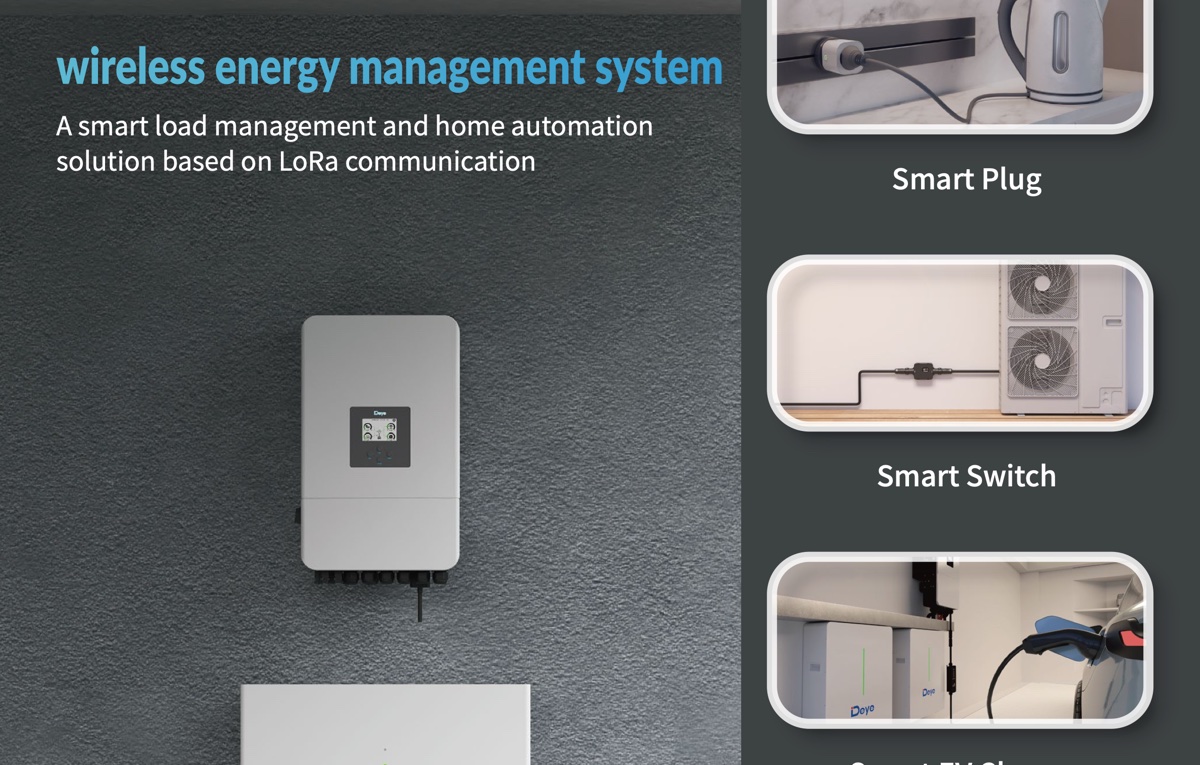
For households and smaller operations, Deye offers a wireless energy management system. The control centre is the hybrid inverter itself — the system supports all Deye hybrid inverters. A Smart TX transmitter is plugged into the Meter port on the inverter and paired with further devices:
- Wireless CT (SUN-SMART-CT01) — DIN-rail meter for the distribution board, for single- and three-phase connections, communicates via LoRa and RS485, range approximately 200 m.
- Smart Plug — a socket that turns an ordinary appliance into a controlled appliance.
- Smart Switch (SUN-SMART-SWITCH01P3) — switch for high-power outdoor appliances, single- and three-phase, up to 25 A, IP65 protection rating — for example for a heat pump or pool heating.
- Smart EV Charger — electric vehicle charger with the modes Plug & Play, scheduled charging and charging from solar energy only, for example the Deye SUN-EVSE11K01-EU-AC wallbox (11 kW).
For each Smart Plug and Smart Switch you set, in the Deye Cloud app or directly on the inverter display, when it should switch on — according to the time and the battery state of charge (SOC). Solar surplus therefore goes to appliances instead of being sold to the grid, and less important appliances switch off when the battery is low.
Why LoRa and not WiFi? LoRa devices respond faster and communicate locally, so they work even without the internet. According to the manufacturer, the response time of the zero export function is 0.2 s when measuring via LoRa and 3–5 s for WiFi devices.
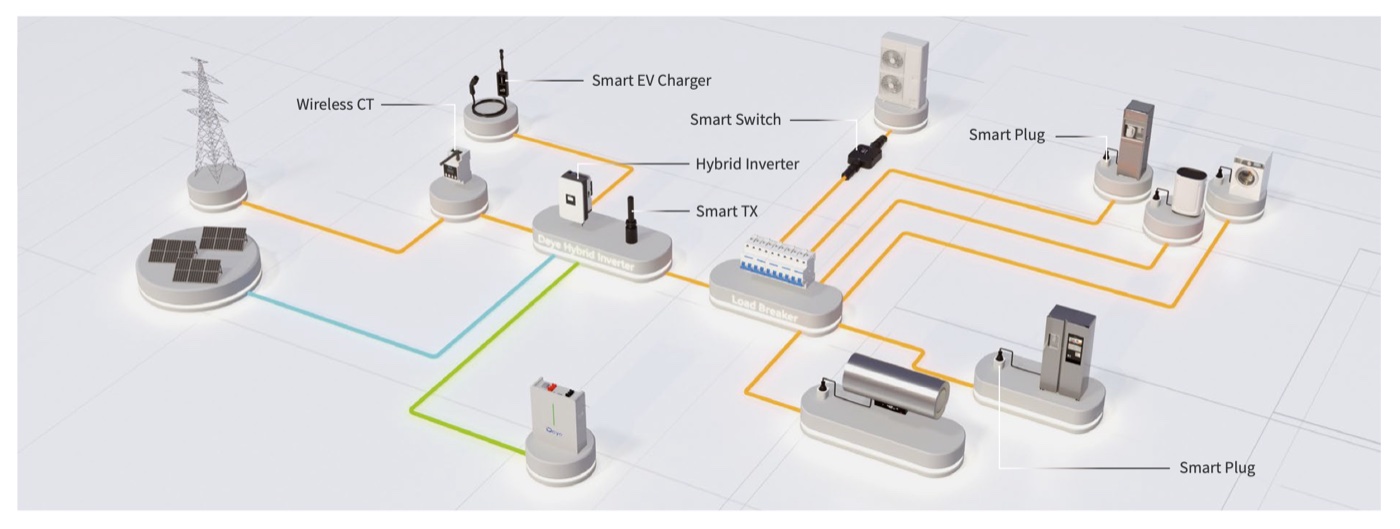
Deye Wireless EMS — the hybrid inverter controls appliances via LoRa (source: Deye)
3. EMS for businesses: Deye GE-F storage systems
In commercial systems, the EMS is a direct part of the storage system. The GE-F120-2H2 combines a 50 kW hybrid inverter, BMS and EMS with a 122.8 kWh battery in a single outdoor cabinet. With the GE-F256 battery cabinet and the inverter SUN-125K-SG02HP3-EU-GM10, the system is controlled by the Deye “3S” concept — EMS, PCS and BMS from a single manufacturer.
The Deye Cloud platform adds real-time device monitoring, intelligent charging and discharging strategies and a separate add-on for dynamic electricity tariffs.
Frequently asked questions
Does Deye have an EMS?
Yes. Basic energy management is in every Deye hybrid inverter, Deye Wireless EMS via LoRa is used to control appliances, and the GE-F commercial storage systems have an integrated EMS.
Do I need a separate EMS with a Deye inverter?
For a family home, generally not — time slots, grid export limitation or operation with a generator are handled by the inverter itself. Wireless EMS pays off if you want to switch specific appliances on automatically (water heating, heat pump, car charging) according to the solar surplus.
Does Deye Wireless EMS work without the internet?
Yes. The devices communicate with the inverter locally via LoRa; the internet is needed only for remote configuration and monitoring in the Deye Cloud app.
Interested in energy management with Deye?
Hybrid inverters, the Deye wallbox and GE-F commercial storage systems can be found in the catalogue. To ask about the availability of other Deye Wireless EMS components, contact sales@sk-partner.sk — we will help design the wiring for your site.